Transform Your Creative Vision with Mood Board Templates for Canva
In the world of design, whether you are redecorating a living room or launching a new fashion line, the initial spark of inspiration is often scattered across different sources. You might have a texture from a magazine, a color from a sunset, and a font style from a vintage poster. The challenge is not finding inspiration, but organizing it into a cohesive narrative. This is where the power of a visual tool comes into play, specifically Mood Board Templates for Canva. These templates serve as the bridge between abstract ideas and tangible reality, allowing you to curate a look that truly inspires.
The Practical Magic of Visual Curation
For many, the blank canvas is the most intimidating part of the process. Starting from scratch requires not only creative energy but also technical layout skills. However, the landscape has shifted with the availability of high-quality Mood Board Templates for Canva. These tools are designed to remove the friction of layout design, allowing you to focus purely on the aesthetics.
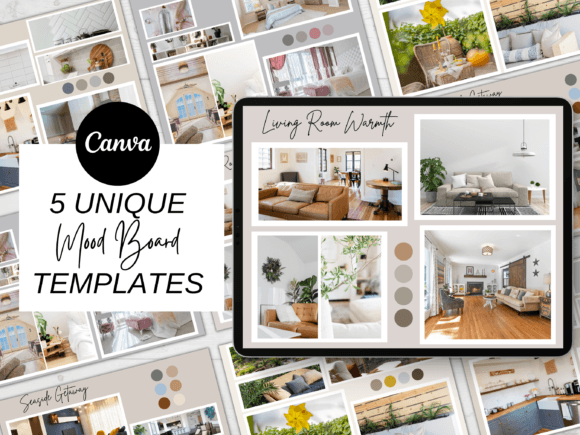
Consider the interior design process. You are trying to explain to a client—or yourself—how a velvet emerald sofa interacts with brass light fixtures and concrete flooring. Spreadsheets and lists fail to capture this feeling. A mood board, however, captures the atmosphere instantly. By using Mood Board Templates for Canva, you can drag and drop these elements into a pre-arranged, beautiful layout. The templates included in this specific package offer five unique designs, ensuring that your presentation looks professional and intentional, rather than cluttered.
Why Canva is the Modern Designer’s Workshop
The choice of platform matters. In the past, creating a professional mood board required expensive software like Adobe Illustrator or Photoshop. These programs have steep learning curves and subscription costs that can be prohibitive for freelancers, students, or hobbyists. Canva has democratized this process. It is a browser-based tool that is intuitive and powerful.
When you acquire Mood Board Templates for Canva, you are buying into an ecosystem of ease. You do not need to install heavy software on your computer. You simply need a free account. The workflow is seamless: you receive a PDF with a link, click it, and the template opens directly in your Canva workspace. This accessibility means you can work on your project from your desktop at home or refine it on the Canva app while commuting. This flexibility fits perfectly into modern, fast-paced lifestyles where creativity doesn't always happen at a desk.
Deconstructing the Package: What You Get
When investing in digital assets, clarity on deliverables is crucial. This particular set of Mood Board Templates for Canva is structured to be immediately usable. The package includes two PDF digital files. The first is the gateway to the design, containing the direct link to the templates. The second is an instructional guide.
It is worth noting the importance of the instruction file. Even with a user-friendly tool like Canva, knowing the specific steps to edit, save, and download ensures a smooth experience. The instructions provided cover the basics, guiding you on how to change fonts, alter colors, and most importantly, how to download your final creation for print or digital sharing. The size is set to US Letter (11 x 8.5 inches), which is a standard dimension that fits perfectly into presentations, portfolios, or can be printed easily for physical boards.
Designing for Interior Design and Beyond
While the prompt specifically highlights interior design, the utility of these boards extends far beyond home décor. The principles of a mood board—combining images, textures, typography, and color swatches—are universal.
Interior Designers: As mentioned, this is the primary use case. You can visualize a "Boho Chic" bedroom or a "Mid-Century Modern" office. You can place images of furniture next to paint chips and fabric swatches to see how the elements converse with one another.
Brand Strategists: A brand is more than a logo. It is a feeling. You can use these Mood Board Templates for Canva to define a brand's voice. Place images that represent the target audience, typography that reflects the brand's personality (playful vs. corporate), and colors that evoke specific emotions. This becomes the North Star for all future marketing materials.
Event Planners: Whether planning a wedding or a corporate gala, the aesthetic needs to be consistent. A mood board helps visualize table settings, floral arrangements, lighting, and venue decor to ensure the event tells a cohesive story.
Customization: Making the Template Your Own
A template is a starting point, not a cage. The true value of these Mood Board Templates for Canva lies in their flexibility. They are designed to be fully customizable. You are not restricted to the placeholder images or the default color palette.
Typography and Color: You can easily select any text block and change the font to match your project's identity. If your project relies on a monochromatic scheme, you can strip away the colors and apply your own. If you are working with a client who has strict brand guidelines, you can input their specific Hex codes to ensure accuracy.
Imagery: You have two paths for imagery. You can upload your own high-resolution photos—perhaps snapshots of a site visit or specific product shots. Alternatively, you can utilize Canva’s vast library of free stock images. This is particularly useful in the early stages of a project when you might not have custom photography yet but need to convey a specific "vibe" or texture.
Streamlining Modern Workflows
Efficiency is key in creative industries. Clients expect fast turnarounds and high-quality deliverables. Using Mood Board Templates for Canva significantly reduces the time spent on the technical aspects of design. Instead of measuring margins and aligning boxes, you are simply swapping out content.
This efficiency allows for rapid iteration. In a client meeting, if they say, "I like it, but can we try a warmer tone?", you can make those adjustments in real-time. You can duplicate a page within the template and try three different variations without destroying the original concept. This iterative process leads to better results and higher client satisfaction.
Furthermore, the digital nature of these boards makes sharing effortless. Gone are the days of gluing fabric samples onto foam core boards. You can download your finished mood board as a PDF or JPG and email it to stakeholders instantly. It integrates seamlessly into modern digital communication channels like Slack, Trello, or Asana.
Practical Tips for Using Your Templates
To get the most out of your purchase, consider these practical recommendations:
- Start with a Theme: Before you open the template, have a loose concept in mind. Are you going for "Minimalist," "Maximalist," "Industrial," or "Organic"? This will help you select images faster.
- Balance is Key: Use the layout provided in the Mood Board Templates for Canva to balance your elements. If you have a very busy, detailed image, pair it with a solid color block or a simple texture. Avoid overcrowding every square inch of the board.
- Use Text Sparingly: A mood board is primarily visual. Use text to label key elements (e.g., "Wallpaper: William Morris") or to add a short descriptor of the mood, but let the images do the heavy lifting.
- Check Resolution: When uploading your own images, ensure they are high quality. Pixelated images can cheapen the look of an otherwise professional board.
Accessibility and Cost Effectiveness
One of the most compelling arguments for using Mood Board Templates for Canva is the economic factor. Hiring a graphic designer to create a custom mood board layout can be expensive. Purchasing software licenses adds up. These templates offer a high-end design result for a fraction of the cost. They bridge the gap between amateur efforts and professional polish.
Moreover, because Canva is a platform that operates on a "freemium" model, you do not necessarily need a paid Canva subscription to use these templates. The free account provides ample functionality to edit text, colors, and upload images. This makes it an incredibly accessible option for students, startups, and small business owners who need to manage their budgets carefully while still maintaining a professional image.
Conclusion: Elevating Your Creative Process
The creative process should be enjoyable. It should be a time of exploration and discovery, not frustration with technical tools. By integrating Mood Board Templates for Canva into your workflow, you are prioritizing the creative vision over the technical execution.
These five unique layouts provide the structure you need to present your ideas clearly and beautifully. Whether you are a professional interior designer presenting to a high-end client, or a hobbyist planning your next personal project, these templates provide the foundation for success. They are versatile, easy to use, and designed to help you create a look that not only inspires but also communicates effectively. Embrace the simplicity of the tool and let your creativity take center stage.